
### Quick Summary: Pusoy Dos Fast Facts
* Game Genre: Shedding card game (often referred to regionally as Big Two or Philippine Poker)
* Player Capacity: Exactly 4 players using a single standard 52-card deck (13 cards dealt per player)
* Starting Card: The player holding the 3 of Clubs (3♣) must open the first round of play
* The Ultimate Single Card: The 2 of Spades (2♠)—the highest individual card in the game
* Standard Suit Hierarchy (Philippines): Diamonds (♦) < Clubs (♣) < Hearts (♥) < Spades (♠)
* Core Objective: Empty your 13-card hand before all opposing players while managing control cards to inflict penalty points on opponents.
Alongside Tongits, Pusoy Dos forms the backbone of traditional Filipino card culture. Played in family living rooms, barangay street corners, and casual gatherings throughout the archipelago, Pusoy Dos is a fast-paced shedding game where tactical timing, hand deception, and memory play decisive roles.
Now digitized for competitive online play on platforms like JLJL6, Pusoy Dos pits four players against one another in real time. While the ultimate objective—shedding all 13 cards first—is straightforward, succeeding consistently requires deep knowledge of combination hierarchies, controlling the tempo of lead cards, and understanding penalty mechanics like the brutal 13-card "Burn" penalty. This comprehensive technical guide breaks down the rules, card ranks, 5-card poker hands, and strategic frameworks of Pusoy Dos.
The Hierarchy of Cards and Suits in Philippine Rules
Unlike standard Western poker where Aces are the highest cards and suits do not break numerical ties, Pusoy Dos operates on a unique card and suit valuation system tailored specifically for shedding mechanics.
Card Value Hierarchy (Lowest to Highest):
[ 3 ] ──> [ 4 ] ──> [ 5 ] ──> [ 6 ] ──> [ 7 ] ──> [ 8 ] ──> [ 9 ]
                                                              │
[ 2 (Highest) ] <── [ Ace ] <── [ King ] <── [ Queen ] <── [ Jack ] <── [ 10 ]
The Power of the Deuce (Dos):
The number 2 (Dos) reigns supreme over all other individual card ranks. An Ace cannot beat a 2. Even a King or Queen is merely a mid-tier card when compared to the dominance of the Twos.
Philippine Suit Hierarchy:
When two players play the exact same card rank (e.g., both play a single 2 or a pair of Kings), the tie is broken strictly by suit:
Philippine Suit Ranking (Lowest to Highest):
[ 1. Diamonds ♦ (Lowest) ] ──> [ 2. Clubs ♣ ] ──> [ 3. Hearts ♥ ] ──> [ 4. Spades ♠ (Highest) ]
- The 3 of Clubs (3♣): The lowest card in the deck. The player dealt the 3♣ is required to lead the very first trick of the match, and their opening play must incorporate that card.
- The 2 of Spades (2♠): The single most powerful card in the game (the Big Two). Nothing can beat a 2♠ played as a single, guaranteeing the holder total control of the lead.
Valid Card Combinations and Trick Mechanics
Pusoy Dos is played in sequential tricks moving counterclockwise around the table. Players can only respond to an opponent's play with a higher-ranking combination of the exact same category and card count.
Valid Combination Categories:
┌─────────────────┬───────────────────────────────┬────────────────────────────┐
│ Combination     │ Composition                   │ Beat Condition             │
├─────────────────┼───────────────────────────────┼────────────────────────────┤
│ Single          │ 1 Card                        │ Higher rank, or same rank  │
│                 │                               │ with higher suit           │
├─────────────────┼───────────────────────────────┼────────────────────────────┤
│ Pair            │ 2 Cards of matching rank      │ Higher rank pair, or same  │
│                 │                               │ rank with higher top suit  │
├─────────────────┼───────────────────────────────┼────────────────────────────┤
│ Three-of-a-Kind │ 3 Cards of matching rank      │ Higher rank triple         │
├─────────────────┼───────────────────────────────┼────────────────────────────┤
│ 5-Card Hand     │ 5 Cards (Poker hand rankings) │ Higher poker hand category │
└─────────────────┴───────────────────────────────┴────────────────────────────┘
5-Card Hand Ranking Hierarchy (Lowest to Highest)
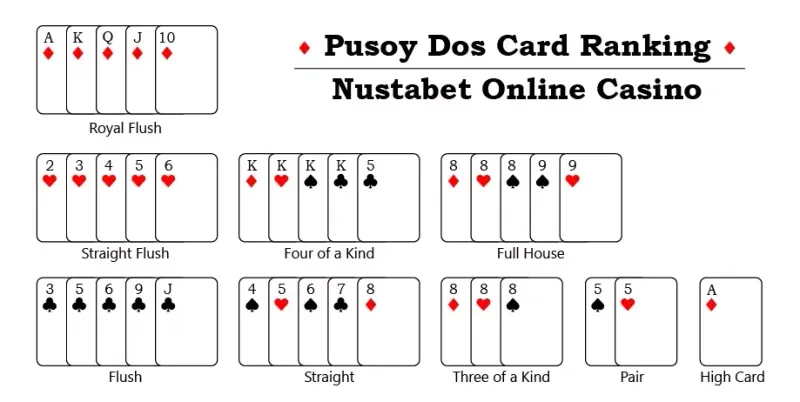
When a 5-card combination is led, all following players must play a 5-card combination. A higher-tier 5-card hand beats any lower-tier 5-card hand regardless of the ranks involved:
5-Card Poker Hand Hierarchy:
[ Straight ] ──> [ Flush ] ──> [ Full House ] ──> [ Four of a Kind ] ──> [ Straight Flush ]
- Straight (5 Consecutive Cards): Ranked by the highest card in the run. (Note: Straights can incorporate 2s in specific sequences depending on house table rules; a standard 2-3-4-5-6 is evaluated based on the 2).
- Flush (5 Cards of the Same Suit): In Philippine rules, a Flush is ranked first by its suit, then by its highest card rank. A Spade flush automatically beats a Heart flush.
- Full House (Three of a Kind + a Pair): Ranked strictly by the rank of the Three of a Kind. A 4-4-4-K-K beats a 3-3-3-A-A.
- Four of a Kind (Quads + 1 Single Card): Ranked by the rank of the four matching cards.
- Straight Flush / Royal Flush: 5 consecutive cards sharing the exact same suit. The undisputed premier 5-card combination.
Match Flow: Dealing, Leading, and Passing
A standard match of Pusoy Dos follows a structured cycle:
Pusoy Dos Round Flow:
┌────────────────────────────────────────────────────────┐
│ 1. Deal: 52 cards dealt equally (13 cards per player) │
├────────────────────────────────────────────────────────┤
│ 2. Opening Trick: Player with 3♣ leads must play 3♣    │
│    (Can be Single 3♣, Pair of 3s, or 5-card with 3♣)   │
├────────────────────────────────────────────────────────┤
│ 3. Trick Progression: Counterclockwise rotation        │
│    Players must play HIGHER matching combination       │
│    OR declare "Pass"                                   │
├────────────────────────────────────────────────────────┤
│ 4. Regaining Control: When 3 players pass in a row,   │
│    the trick clears; the last player LEADS A NEW TRICK │
├────────────────────────────────────────────────────────┤
│ 5. Victory: First player to empty their 13 cards wins │
│    Remaining players assessed penalties per card held  │
└────────────────────────────────────────────────────────┘
The Strategic Value of "Regaining Control"
When three consecutive players pass, the trick ends and the played cards are cleared to the discard pile. The player who played the highest card or combination earns the Lead.
Earning the lead is the most valuable tactical position in Pusoy Dos because it allows you to change the combination category. If an opponent has been dominating the table with single 2s and Aces, winning the lead lets you switch immediately to Pairs or 5-card hands, forcing them to break up their holdings or pass.
The Dragon Hand (Automatic Win)
Before standard play begins, players examine their initial 13-card hand for rare instant-win conditions known as Dragon Hands.
The Ultimate Dragon Hand:
[ 3 - 4 - 5 - 6 - 7 - 8 - 9 - 10 - J - Q - K - A - 2 ]
(All 13 cards forming a complete unbroken sequence from 3 to 2)
- The Payout: If a player is dealt an unbroken sequence containing one of every card rank from 3 through 2, they reveal their hand immediately before the first trick is played.
- Instant Victory: The round ends instantly. The player holding the Dragon hand is declared the winner, and all three opposing players are assessed maximum penalty losses as if they held a full 13-card hand.
Penalty Scoring and the "Burn" (Sunog) Rule
Online Pusoy Dos on JLJL6 uses point-based settlement systems where your profit or loss is determined by the number of cards remaining in your hand when the winner plays their final card.
Standard Penalty Calculations:
┌──────────────────┬─────────────────────────────┬──────────────────────────┐
│ Cards Remaining  │ Penalty Multiplier          │ Severity Classification  │
├──────────────────┼─────────────────────────────┼──────────────────────────┤
│ 1 to 7 Cards     │ 1x Base Unit Per Card       │ Standard Loss            │
│ 8 to 9 Cards     │ 2x Doubled Penalty Per Card │ Heavy Loss               │
│ 10 to 12 Cards   │ 3x Tripled Penalty Per Card │ Severe Loss              │
│ 13 Cards (Sunog) │ 4x Quadrupled Penalty (Max) │ CATASTROPHIC (Burned)    │
└──────────────────┴─────────────────────────────┴──────────────────────────┘
The Catastrophic Sunog (13-Card Burn):
If a player fails to shed even a single card before the winner empties their hand, that player is declared Sunog (Burned).
- They are assessed the maximum quadrupled penalty across all 13 cards.
- In addition, in many tournament formats, holding an unplayed 2 in your hand when the match ends incurs additional penalty point deductions.
- Therefore, your secondary objective in every match is to break your hand and play at least one card to escape the severe Sunog multiplier.
Tactical Frameworks for Competitive Pusoy Dos
Succeeding in digital Pusoy Dos requires balancing aggressive shedding with defensive hand management.
Tactical Decision Matrix:
1. Identify Control Cards Early:
   Count your Twos and Aces. These are your "entry tickets" to regain the lead.

2. Structure Multi-Card Combinations:
   Organize into 5-card hands and pairs first; leave singles for when you hold control.

3. The "Unloading Rule":
   If an opponent drops to 1 or 2 cards, never lead a low single.
   Force them into 5-card hands or pairs where they are vulnerable.
Managing the 2 of Spades:
The 2♠ is your most powerful weapon, but using it too early is a common beginner mistake.
- If you play the 2♠ on the second trick simply to win a low single, you burn your trump card early and leave your remaining low singles (4s, 5s, 6s) defenseless.
- Hold the 2♠ until you can use it to seize the lead at a decisive moment—ideally when winning the lead will allow you to play your remaining 5-card hand or clean pair to finish the game.
Bankroll Discipline and Table Sizing on JLJL6
Online Pusoy Dos tables operate with designated point values (e.g., ₱1.00, ₱5.00, or ₱20.00 per point). Because a single Sunog can cost over 50 points, managing your bankroll relative to the table point value is essential.
Total Session Bankroll (e.g., ₱3,000)
              │
              ▼
Divide by 100 Maximum Point Losses (Select a ₱1.00 or ₱2.00 point table)
              │
              ├──> Strict Defense: Shed cards early to avoid 8+ card penalty multipliers
              │
              ├──> Profit Target (+50% / ₱4,500): Conclude session and cash out via [GCash](https://www.gcash.com/)
              │
              └──> Stop-Loss Limit (-35% / ₱1,950): Step away to protect capital
The 100-Point Rule:
Always ensure your bankroll holds at least 100 maximum point units for the table you choose. If a table is set at ₱5.00 per point, your session budget should be at least ₱2,500. This ensures that an unlucky hand where an opponent achieves a fast win does not deplete your balance.
Mobile Usability: Touch Controls for Fast Card Sorting
Digital Pusoy Dos on JLJL6 features specialized mobile UI enhancements designed for fluid smartphone play.
Mobile Features:
- Automated Card Sorting: Instantly arrange your 13 cards by Rank (3 to 2) or by Suit (♦ < ♣ < ♥ < ♠) with a single tap.
- Combination Highlighting: Tap a 5-card option (like Full House or Flush) and the software automatically highlights valid eligible cards from your hand.
- Fast Turn Timers: 15-second turn timers ensure matches move briskly without unnecessary delays from disconnected players.
- Instant Cashier Connectivity: Seamless integration with Philippine e-wallets enables quick mobile deposits and cashouts via GCash and Maya.
Frequently Asked Questions
What is the ranking of suits in Philippine Pusoy Dos?
In Philippine Pusoy Dos rules, suits rank from lowest to highest as: Diamonds (♦), Clubs (♣), Hearts (♥), and Spades (♠). The 2 of Spades (2♠) is the highest individual card in the game, while the 3 of Clubs (3♣) is the lowest.
Who starts the first round of Pusoy Dos?
The player who is dealt the 3 of Clubs (3♣) must open the first trick of the game. Their opening play must include the 3 of Clubs, which can be played as a single card, as part of a pair (e.g., two 3s), or within a valid 5-card poker combination.
What is a Dragon Hand in Pusoy Dos?
A Dragon Hand is a rare instant-win combination where a player is dealt a complete, unbroken sequence of all 13 card ranks from 3 up to 2 (3-4-5-6-7-8-9-10-J-Q-K-A-2). Revealing a Dragon Hand ends the match immediately and awards maximum penalty points from all opponents.
What happens if I am "Sunog" (Burned) in Pusoy Dos?
If another player empties their hand before you manage to play a single card (leaving you with all 13 cards), you are declared Sunog (Burned). You are penalized with the maximum quadrupled point deduction for that round.
Can a Flush beat a Straight in Pusoy Dos?
Yes. 5-card combinations follow traditional poker hand rankings: Straight < Flush < Full House < Four of a Kind < Straight Flush. A Flush of any suit will beat any Straight.
What are the fastest payment methods for cashing out Pusoy Dos winnings on JLJL6?
The fastest payment options for Philippine players on JLJL6 are verified e-wallets including GCash and Maya, with withdrawals typically completed within 10 to 20 minutes following account verification.
Internal Silo Links and Related Resources
- Parent Silo Hub: /casino/
- Explore Sibling Table & Card Guides:
- Tongits Online Guide
- Live Baccarat Strategy Guide
- Live Blackjack Guide
- Color Game Online Guide
- Mines Arcade Game Guide
- Cashier & Transaction Walkthroughs:
- GCash Deposit Guide
- GCash Withdrawal Guide
- Platform Trust & Compliance:
- Review Testing Methodology
- Responsible Gaming & Player Protection
### Responsible Gaming Notice (21+)
Pusoy Dos is a traditional skill-and-chance card game intended for recreational entertainment. Point-based card play carries financial risk. Set strict loss limits and never wager money required for personal or family living expenses. If you or someone you know requires assistance regarding gaming habits, please reach out for free, confidential support at BeGambleAware or Gamblers Anonymous.